- Home
- Trend
- Weight Loss Strategies
- Acne Tips
- Hair Health Information
- Blemish Removal Tips
- Acne Scar Removal Tips
- Muscle Building Techniques
- Intimate Care Tips
- Postpartum Intimate Care
- Eye Bags Wiki
- Tips for Face Slimming
- Secret of Permanent Hair Removal
- Breast Enlargement Tips
- Cure to Snoring
- Marionette Lines
- Skin-Tightening Secrets

Sunspots often creep up silently and turn your complexion patchy and uneven. What exactly do sunspots look like? Are they the same as solar lentigines? How are they different from other types of pigmentation? Do not worry — this article breaks down the causes, characteristics, and categories of sunspots, plus effective methods to lighten and remove them. We also share how medical aesthetics can help you get rid of sunspots easily and safely.

What Are Sunspots? Definition and Causes of Sunspots
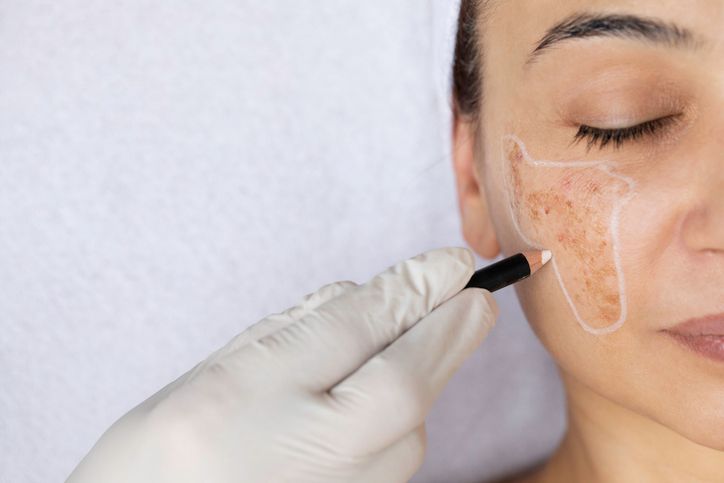
Sunspots — also known as solar lentigines or age spots — are one of the most common pigmentation concerns. They primarily result from long-term UV exposure, which disrupts melanocyte function and leads to excessive melanin production. When your skin is exposed to UV rays over time, melanocytes become overactive and generate more melanin than the skin can naturally process. This excess melanin accumulates in the epidermis and eventually appears on the skin surface as visible sunspots. In short, UV radiation is the main culprit.
Common Causes of Sunspot Formation
Aside from UV exposure, several lifestyle and environmental factors also increase the risk of developing sunspots:
1. Insufficient sun protection: One of the most common root causes. Without daily sunscreen or when sunscreen is inadequate, UV damage accelerates melanin buildup, forming sunspots.
2. Lack of proper skincare: As we age, the skin’s self-repair capability and defense mechanism weaken. Without proper skincare, the skin becomes more vulnerable to external aggressors and prone to sunspot development.
3. Using photosensitizing skincare ingredients: Ingredients such as retinoic acid, retinol, AHA, and salicylic acid increase UV sensitivity. Without strict sun protection while using these ingredients, pigmentation forms more easily.
4. Skincare without antioxidants: Antioxidants like vitamin C, vitamin E, niacinamide, glutathione, and peptides help neutralize free radicals and reduce UV-induced damage. Without them, the skin becomes weaker and more prone to sunspots.
5. Irregular lifestyle and lack of sleep: Poor sleep affects skin renewal, making pigmentation more likely to accumulate. Long-term sleep deprivation also weakens skin repair.
6. Unbalanced diet: A diet lacking antioxidants (especially vitamins C and E) lowers the skin’s defense and accelerates UV-related pigmentation. Balanced nutrition is crucial for skin health.
Types of Sunspots and How to Identify Them
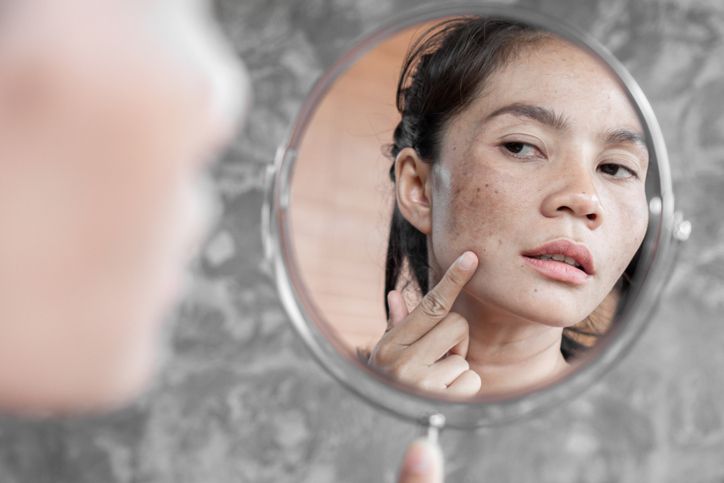
Understanding different pigmentation types is key to choosing the right solution. Dermatology generally categorizes dark spots into three groups based on pigment depth: epidermal, dermal, and mixed-type pigmentation.
Epidermal Pigmentation
• Location: Epidermis
• Characteristics: Sharply defined borders
• Examples: Freckles, mild sunspots, early-age spots
• Treatment: Brightening skincare or laser treatments
Dermal Pigmentation
• Location: Dermis
• Characteristics: Blurred borders
• Examples: Ota nevus, Hori’s nevus
• Treatment: Advanced laser or brightening injectables, more difficult to treat
Mixed-Type Pigmentation
• Location: Between epidermis and dermis
• Characteristics: Borders are partially defined
• Examples: Melasma, Becker’s nevus
• Treatment: Typically requires medical aesthetic treatments due to complex causes
免費體驗
PicoCure Pigmentation Removal Treatment
1 Minute Self-Registration
Date should not be before minimal date
Common Pigmentation Comparison: Sunspots, Freckles, Melasma, Age Spots, Café-au-Lait Spots
| Name | Sunspots | Freckles | Melasma | Age Spots | Café-au-Lait Spots |
|---|---|---|---|---|---|
| Pigment Type | Epidermal | Epidermal | Mixed | Epidermal | Epidermal |
| Colour | Dark brown, brown-black | Red or light brown | Brown, brown-grey, blue-grey | Yellow-brown or black | Coffee-brown |
| Shape | Grain-sized flat spots | 1–2 mm irregular dots | Large, symmetrical patches | Soybean-sized or larger, may be raised | Oval or irregular |
| Main Cause | Long-term UV exposure | Genetics | Hormonal changes | Skin aging, keratin buildup, UV | Congenital |
| Common Areas | Face, cheeks, nose, arms, hands, neck | Nose, cheeks, neck, hands | Face | Face, hands, arms, neck | Whole body |
How to Remove Sunspots? Effectiveness and Treatment Options
Sunspots rarely fade on their own and are difficult to eliminate through skincare alone. For true, measurable improvement, medical aesthetic treatments are often the most effective.
Laser Treatments for Sunspot Removal
Laser pigmentation removal is one of the most effective treatments, using specific wavelengths to precisely break melanin into tiny particles that the body naturally clears.
Picosecond Laser Results
Picosecond lasers operate with ultra-short pulses (one trillionth of a second) that generate a strong photoacoustic effect to shatter pigment with minimal heat damage, reducing recovery time and the risk of post-inflammatory hyperpigmentation.
Ultra Picosecond (2nd Generation) Results
Ultra Picosecond technology offers even shorter pulses and higher peak power, breaking melanin into finer particles for faster clearance. It is particularly effective for stubborn deep or mixed-type pigmentation and also stimulates collagen for smoother, firmer skin.
Other Treatments
• Q-switch laser: Gentle improvement of uneven skin tone
• IPL: Multi-wavelength light to lighten pigmentation and refine skin texture
• Radiofrequency (Silicon Valley RF): Stimulates collagen renewal to support pigment reduction
Topical Medication for Pigmentation
Common dermatologist-prescribed ingredients include:
• Hydroquinone: Inhibits melanin production
• Retinoic acid, azelaic acid: Accelerates skin turnover and aids pigment elimination
Topical treatments must be medically supervised.
Daily Lightening and Prevention: Skincare Strategies to Stop Sunspots
1. Strengthen Sun Protection
• Use SPF30+ and PA+++ or above daily
• Reapply every 2 hours outdoors
• Combine with physical protection (umbrella, sunglasses, hat)
2. Healthy Lifestyle
• Ensure sufficient sleep for optimal skin repair
• Eat antioxidant-rich foods: guava, kiwi, broccoli, avocado, nuts
3. Choose the Right Brightening Skincare
Look for vitamin C, arbutin, tranexamic acid, niacinamide. Be aware: acid-based ingredients increase sun sensitivity — strict sun protection is essential.
免費體驗
PicoCure Pigmentation Removal Treatment
1 Minute Self-Registration
Date should not be before minimal date
Medical-Grade Picosecond Laser — The Fastest and Most Effective Solution
While daily prevention helps, modern lifestyles make consistency difficult. If you want faster and more visible results, professional picosecond laser treatments offer precise, high-efficiency pigment reduction with minimal discomfort and downtime.
30-Minute Sunspot and Solar Lentigo Removal: PicoCure Pigmentation Removal Treatment
Conventional skincare cannot eliminate large, stubborn melanin clusters. They must be shattered into fine dust-like particles before the body can clear them.
Perfect Medical’s PicoCure 2nd-Generation Ultra Picosecond Treatment improves sunspots, age spots, melasma, acne marks, dullness, and uneven tone in just 30 minutes.
Using multiple wavelengths, melanin at various skin depths is shattered into ultra-fine particles. Results are visible immediately as pigmentation fades progressively through skin metabolism.
• Non-invasive
• No pain
• No risk of rebound pigmentation
Perfect Medical currently offers a free PicoCure trial, including a complimentary professional skin analysis.
免費體驗
PicoCure Pigmentation Removal Treatment
1 Minute Self-Registration
Date should not be before minimal date
FAQ

Can I still get sunspots even if I use sunscreen?
Yes. Sunscreen reduces but cannot fully block all UV. Lifestyle habits and sun exposure also contribute. Combine sunscreen with physical protection.
How long is the recovery period after laser pigmentation removal?
Typically a few days to one week. Mild redness or scabbing is normal. Deeper pigmentation may require multiple sessions.
How do I treat sunspots on my arms?
Use sunscreen and body brightening products, or opt for picosecond laser treatment for faster results.
Can sunspots be prevented?
Yes. Consistent sun protection, proper skincare, sleep, and diet significantly reduce formation.
Are sunspots and age spots the same?
They share similar UV-related causes, but age spots are often larger and may be raised, while sunspots are flat.